Did Scientists Just Discover a New Type of Superconductivity with 'i-Wave' Symmetry? This Could Be Huge for Quantum Computing.
科学家刚刚发现了具有‘i波’对称性的新型超导态?这可能彻底改变量子计算的未来。
www.nature.com
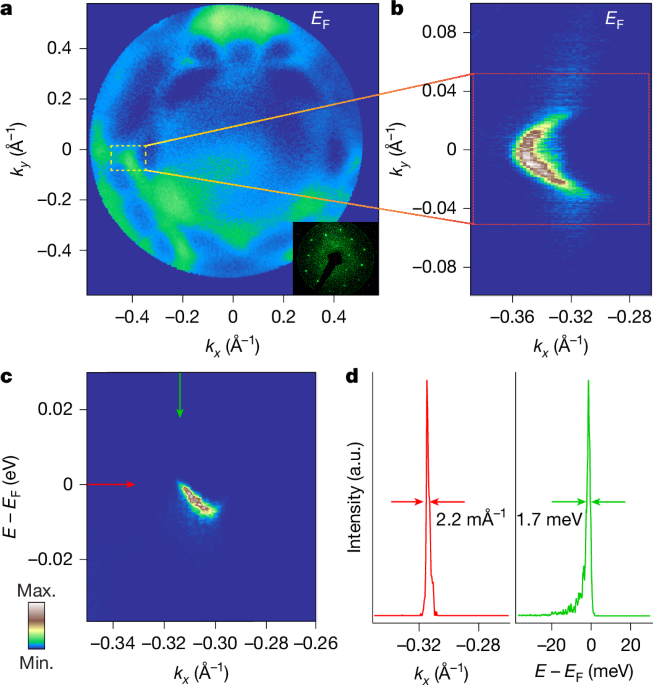
Hold up—did they just claim to observe i-wave superconductivity in PtBi2? That’s not just 'unconventional'—that’s like saying you found a new element in your backyard. The paper argues that ARPES data shows nodal gaps along Fermi arcs, implying six surface Majorana cones due to i-wave (l = 6) pairing symmetry. If this holds, it’s the first solid spectroscopic evidence of a topological superconductor with pairing beyond d-wave.
等等——他们真的声称在PtBi2中观察到了i波超导态?这已经不只是‘非常规’了,简直就像在自家后院发现了新元素。论文指出,ARPES数据显示费米弧上存在节点能隙,表明由于i波(l=6)配对对称性,表面出现了六个马约拉纳锥。如果结论成立,这将是首个超越d波配对的拓扑超导体的确凿光谱证据。
But here’s the kicker: the Majorana cones are anomalous—one surface has six cones of the same winding number, which shouldn’t be possible in a standalone 2D system. The resolution? They’re only stable because of the 3D bulk. This makes PtBi2 a candidate for an ‘anomalous topological superconductor.’ Still, zero bulk gap means quantum computing applications are limited… for now.
但关键点在于:这些马约拉纳锥是反常的——一个表面有六个相同缠绕数的锥,这在独立的二维系统中本不可能存在。解决方案是什么?它们之所以稳定,是因为三维体态的存在。这使得PtBi2成为‘反常拓扑超导体’的候选材料。不过,体态无能隙意味着其在量子计算中的应用目前仍有限制。
好吧,我承认——这是我几年来读过最令人兴奋的超导论文。他们用改进的激光ARPES将费米弧解析得如此清晰?半高宽达1.7 meV和2.2 mÅ⁻¹?分辨率简直惊人。他们不只是看到了能隙,还绘制了各向异性,确认了节点,并通过群论将其与i波对称性联系起来。这是清晰、直接的光谱证据,不再是Sr₂RuO₄那样的悬案。
先别激动。该材料的体态没有能隙。这对拓扑量子计算来说是致命缺陷。你不可能让受保护的量子比特在体态准粒子中游荡。是的,表面马约拉纳锥很酷,但若体态无能隙,任何边缘态都会变得脆弱。这还远未达到‘可用于拓扑量子计算’的程度,顶多算‘有趣的反常现象’。
我理解你对体态能隙的担忧,但论文明确建议可通过制备超薄样品来抑制体态模式。它虽未‘就绪’,但已指明路径。而且与Sr₂RuO₄不同,它拥有直接的ARPES证据。别因小失大。
从器件角度看,步边铰链模式其实比表面锥更实用。如果你能在台阶边缘局域化马约拉纳态,那就有了一个易于制造的平台。无需完美二维薄膜。这可能比纳米线方案更容易集成。
所以……这是否意味着我们离真正的量子计算机又近了一步?还是说现在下结论还太早?
给爱好者:这确实是激动人心的科学,没错。明天就实现量子计算机?不可能。从拓扑态到量子比特还有很长的路要走。但必须承认——这是一项优雅的工作。只是别让炒作跑在科学前面。
这肯定会成为‘年度量子材料’的头条新闻。而且实至名归。但我敢打赌,一半的科普文章会把‘i波’误解成某种神奇的波函数。语境很重要。这是群论,不是玄学。
没错。每次出现‘马约拉纳发现’,媒体就疯狂炒作。这可不是粒子探测器的结果。而是一项精妙的光谱推断。让我们为这份智慧喝彩——但别失去严谨性。